


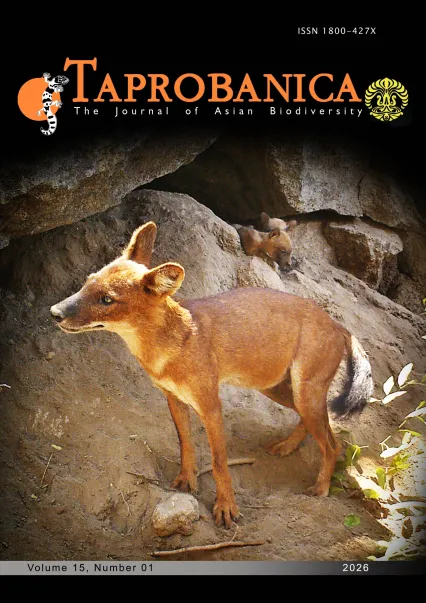

v15i1.403
Volume 15 | Number 1 | 2026
Major Article
eISSN: 1800-427X (online)
DOI:10.47605/tapro.v15i1.403
Submitted date: 12 February 2025
Accepted date: 31 May 2025
Published date: 31 May 2026
Pp. 74–86.
HABITAT SUITABILITY AND PREY RICHNESS PREDICT DISTRIBUTION CONSTRAINTS OF THE ENDANGERED DHOLE, Cuon alpinus (MAMMALIA: CARNIVORA) IN WEST SUMATRA
Inda D. Solina*, Wilson Novarino, Muhammad H. Saputra, Rajif Iryadi, Aditya Hani, Eko Pujiono, Wieke Herningtyas, Nida Humaida, Jalma G. Sukmawati,
Muhammad B. Atmaja, Reni S. Wahyuningtyas & Sutomo Sutomo
*Corresponding author. E-mail: solina.inda@gmail.com
Abstract
The endangered Cuon alpinus faces severe habitat fragmentation and population decline across Asia, including Sumatra, where both the species and its prey are increasingly threatened. Limited ecological data further constrain conservation efforts. This study identifies suitable habitats for dholes and their prey in West Sumatra using MaxEnt modelling, integrating occurrence data from camera traps, GBIF, and Camera Trap Asia with environmental predictors (altitude, land cover, rivers, roads, and bioclimatic variables). Potential prey included mammals from 12 families and one avian family. Dholes were confirmed at nine locations, and model performance was robust (AUC > 0.8, mostly > 0.9). Only 4% of West Sumatra was predicted as a highly suitable habitat, concentrated in primary (25.53%) and secondary (39.96%) forests, largely within protected areas. Prey distributions were heterogeneous, with only one family showing broad overlap (33.57%) with dhole occurrence. Land cover was the primary driver of both dhole and prey distributions. These findings highlight a highly constrained habitat for dholes, emphasizing the need to protect and restore primary and secondary forests while maintaining prey diversity. The spatial outputs provide practical guidance for protected area zoning, corridor design, and landscape-level management.
Section Editor: Simon Hedges
DOI:10.47605/tapro.v15i1.403
Submitted date: 12 February 2025
Accepted date: 31 May 2025
Published date: 31 May 2026
Pp. 74–86.
HABITAT SUITABILITY AND PREY RICHNESS PREDICT DISTRIBUTION CONSTRAINTS OF THE ENDANGERED DHOLE, Cuon alpinus (MAMMALIA: CARNIVORA) IN WEST SUMATRA
Inda D. Solina*, Wilson Novarino, Muhammad H. Saputra, Rajif Iryadi, Aditya Hani, Eko Pujiono, Wieke Herningtyas, Nida Humaida, Jalma G. Sukmawati,
Muhammad B. Atmaja, Reni S. Wahyuningtyas & Sutomo Sutomo
*Corresponding author. E-mail: solina.inda@gmail.com
Abstract
The endangered Cuon alpinus faces severe habitat fragmentation and population decline across Asia, including Sumatra, where both the species and its prey are increasingly threatened. Limited ecological data further constrain conservation efforts. This study identifies suitable habitats for dholes and their prey in West Sumatra using MaxEnt modelling, integrating occurrence data from camera traps, GBIF, and Camera Trap Asia with environmental predictors (altitude, land cover, rivers, roads, and bioclimatic variables). Potential prey included mammals from 12 families and one avian family. Dholes were confirmed at nine locations, and model performance was robust (AUC > 0.8, mostly > 0.9). Only 4% of West Sumatra was predicted as a highly suitable habitat, concentrated in primary (25.53%) and secondary (39.96%) forests, largely within protected areas. Prey distributions were heterogeneous, with only one family showing broad overlap (33.57%) with dhole occurrence. Land cover was the primary driver of both dhole and prey distributions. These findings highlight a highly constrained habitat for dholes, emphasizing the need to protect and restore primary and secondary forests while maintaining prey diversity. The spatial outputs provide practical guidance for protected area zoning, corridor design, and landscape-level management.
Section Editor: Simon Hedges
- List of Articles & Contents